What you'll learn
If I offered to personally show you exactly how to stop violent attackers DEAD in their tracks...
Without needing to be fast, strong, or in good physical shape…
Without long, sweat-drenched hours of classes…
Without a gun…
Even if you have no previous fighting experience whatsoever…
Would you be interested?
Who this course is for:
- Does NOT require a lot of time to master—You can learn it, literally, in a couple of hours—even if you're a total fighting "green horn" now.
- Does NOT require you to be in peak physical condition— Guys with bulging beer bellies and bum knees use Close Combat Training to send younger and more experienced fighters—even advanced martial artists—to the emergency room.
- Does NOT require you to be uninjured to work— These are "gross motor movement" techniques. This is why even soldiers with their legs blown off were able to defend themselves against armed enemies closing in on them in trenches and ditches.
- Does NOT require any practice—once you learn it, it's "locked in" your mind, your neurology, and even your muscle fibers forever. You cannot forget it even if you wanted to. It's like a weapon strapped to your leg 24/7—365 days per year—ready to be drawn and fired at a moment's notice at any time, in any place, and under any circumstances.


How Self-Defense Classes Empower You Mentally and Physically
The physical changes are obvious. You’ll get stronger, faster, and have better endurance. But the real magic happens between your ears.
The Mental Armor
Training under controlled stress—like when a partner is trying to grab you or pin you—rewires your brain. It’s like a fire drill for your fight-or-flight response. Instead of freezing in panic, you learn to think and act decisively under pressure.
This builds a deep, unshakable confidence that spills over into every area of your life. You’ll feel more capable at work, more present in your relationships, and more comfortable in your own skin. It’s the feeling the York County program aims for: “the confidence and ability to defend themselves in various situations.” You’re not just learning to fight an attacker; you’re learning to conquer your own fear and self-doubt.
Scheduling and Commitment: Making the Most of Your Training
So, how often do you need to train to see results?
- 1x per week: This is a great start. You’ll learn new things and slowly build skills. It’s in maintenance mode.
- 2-3x per week: This is the sweet spot for real progress. You’ll build muscle memory much faster, improve your fitness, and retain information much more effectively.
- 4x+ per week: You’re officially a hobbyist! This level of commitment will lead to rapid skill acquisition and a deep understanding of the art.
Remember, a one-day seminar is a fantastic introduction, but it’s like drinking from a firehose. You’ll get a lot of information, but you won’t retain much without practice. Ongoing classes are where you build real, lasting skills. Consistency is the secret sauce. Showing up, even when you’re tired, is what separates those who know a few moves from those who are truly capable.


Quick Tips for Practicing Self Defense Outside the Classroom
Your training doesn’t stop when you leave the mat. The most important self-defense happens every day.
- Be Present, Not Paranoid: Put your phone away when you’re walking. Keep your head up. Notice who and what is around you. This isn’t about being scared; it’s about being engaged with your environment.
- Trust Your Gut: That little voice in your head that says “this feels weird” is an ancient survival mechanism. Listen to it. If a person or situation makes you uncomfortable, leave. You don’t need to justify it.
- Walk with Purpose: Body language speaks volumes. Walk with your head up, shoulders back, and at a steady pace. Project confidence, even if you have to fake it.
- Use Everyday Objects: Your keys, a metal water bottle, a pen, or even a rolled-up magazine can be used as a force multiplier in a worst-case scenario.
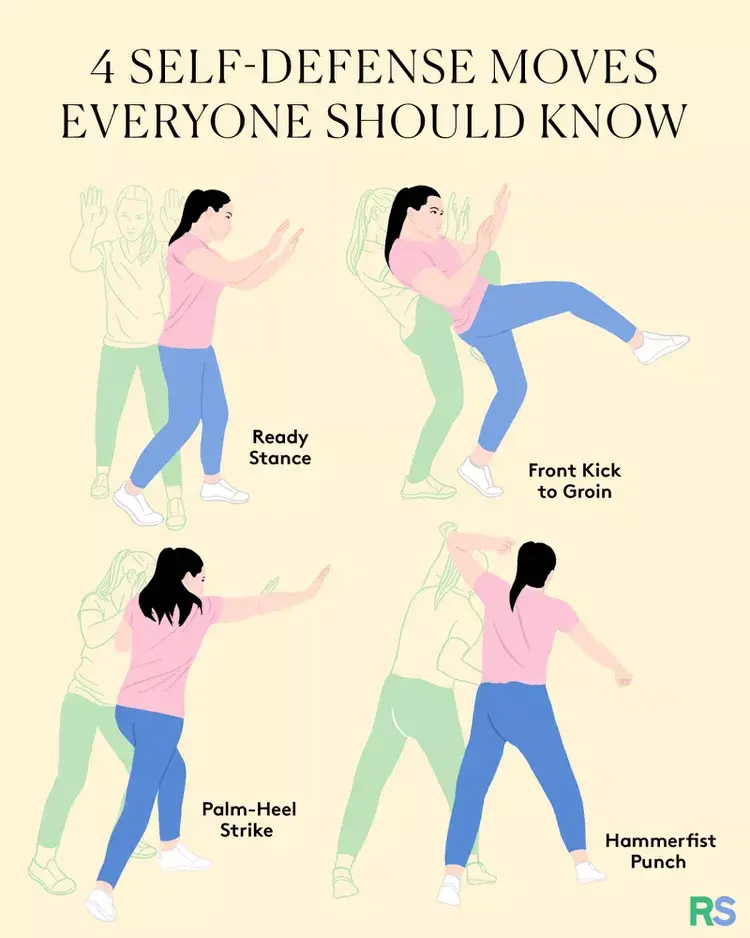
Ready Stance
When to use it: Use this from a distance as a way of setting a strong body-language boundary (like if somebody's following you) or when you're engaged in sending physical strikes. You're more vulnerable on the ground versus standing. Although ending up on the ground during an assault is a real possibility, remaining on your feet should be a priority, says Master Dukes.
How to do it: Stand with your feet shoulder-width apart and your hands by your sides. Keeping your toes pointed forward, take a natural step forward with your non-dominant leg, so your feet are staggered. Bend both knees slightly, elevate the back heel, bring your hands up with your hands about 12 inches from your face and your palms facing forward, tuck your chin, and shrug your shoulders slightly. Distribute your body weight between both feet, placing it more in the balls versus heels.


Palm-Heel Strike
When to use it: This is a last-resort move to create escape opportunities. "It's best used when the face of the attacker isn't blocked or covered, and you can reach the face with your arms outstretched," Master Dukes says.
How to do it: Start in Ready Stance and keep your hands up. Rotating your left hip and shoulder, explosively extend your left palm straight out, with your fingertips straight up and elbow down. Keep your right hand up to protect your face. Immediately recoil your left arm, returning your shoulder and hip to the square ready stance.
With your feet in the same position, send a palm strike with your right hand (be sure to rotate your right hip), then try a left-right combination. If you are left-handed, practice a right-left combination. Your hand should stay open (i.e., don't make a fist), and the heel of your palm should make contact with the attacker's nose.
Areas of an attacker's body that are most vulnerable include not only the eyes, nose, throat, and groin. "Effective striking to these areas is most likely to slow, stun, or stop an attacker long enough to get away," says Master Dukes.
Front Kick to Groin
When to use it: This is another last-resort move to create escape opportunities. It's particularly beneficial against somebody who's tall, Master Dukes says, especially if you can't reach their face for Palm-Heel Strikes.
How to do it: Start in Ready Stance, keeping hands up. Bend your right leg and drive your right knee straight up. As soon as the right knee is above your waistline, extend your hips (almost bend backward to generate power in the left leg/your loading leg) and kick your right shin directly to the attacker's groin, making sure to keep your toes pointed downward and out of the way. Immediately release your right foot behind you and return to Ready Stance.


Hammer fist Punch
When to use it: Rely on the Hammer fist Punch move in almost any situation where you find yourself in danger, Master Dukes says. It's most effective, though, when used to hit the attacker directly in the face, particularly the nose, jaw, or temple.
How to do it: Start in Ready Stance. Raise your dominant hand up, bending at the elbow (like you're preparing to throw a ball). Rotate your hips toward attacker and bring your dominant arm down, smacking the attacker in face (aim for the nose) with the meaty bottom part of fist. If you're practicing this move, recoil to Ready Stance and repeat. In a real-world scenario, strike the punch and run while the attacker is incapacitated.